
How do you soap-clean a patio or other wooden decking?
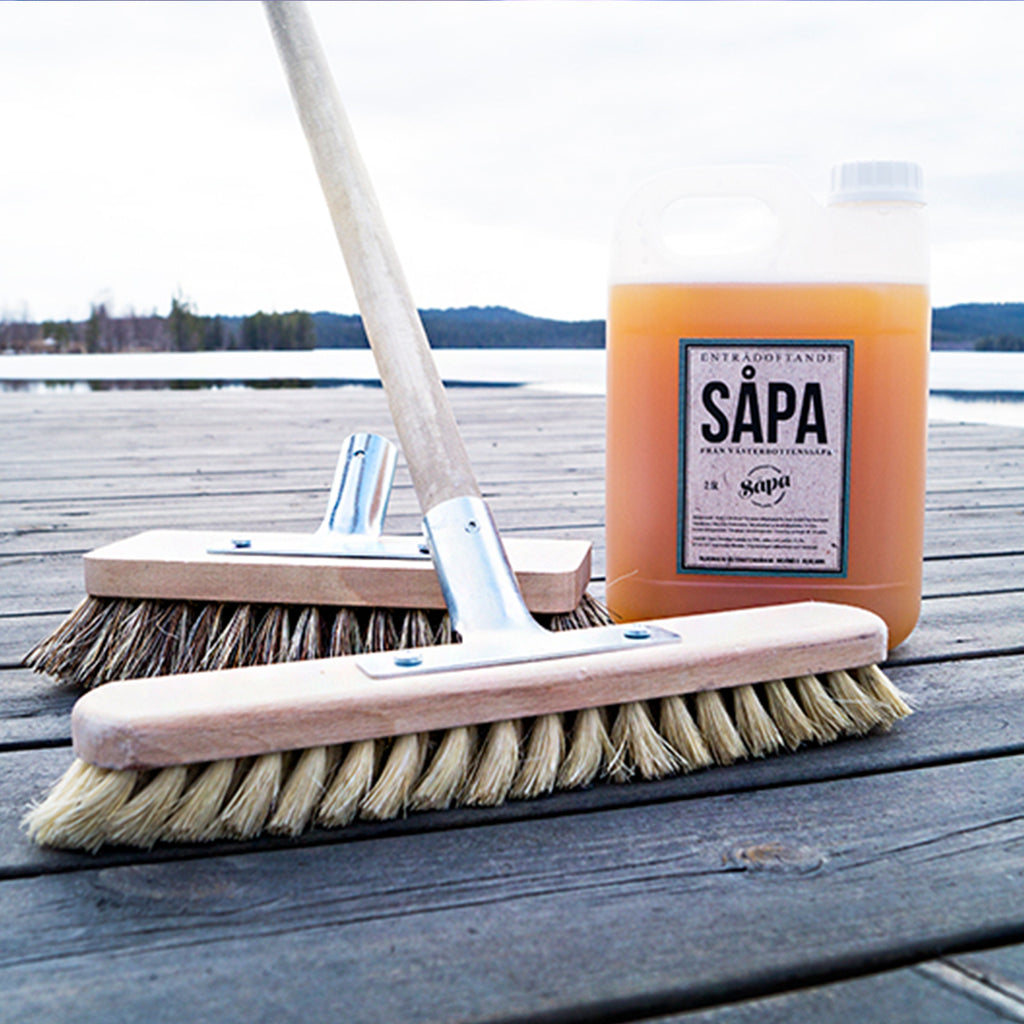
Sara IdenforsSoap the patio or other wooden decking by first scrubbing the patio clean of algae, lichen, and dirt with 10 l of warm water and 1 dl of decking soap (use a stiff brush if needed). Make sure no loose residue remains. Then mix 1 l of soap with 9 liters of cold water and apply the mixture with a scrubbing cloth/scrub brush over the entire surface until the patio wood is saturated, creating a soft, smooth surface.
So what is the advantage of soaping the patio instead of oiling it?
The advantage of soaping the patio instead of oiling it is that the surface becomes smooth and matte, compared with the glossy finish produced by oiling. A soaped floor has the same surface as a traditional scrubbed floor, if you have ever encountered one. The surface becomes smooth, soft, and warm, and after a couple of treatments it develops a waxed feel.
Because the surface becomes matte and smooth, it is easy to sweep clean of pollen, road dust, or other loose dirt. An oiled surface that gets dusty or covered in pollen is more difficult to clean because it becomes slightly sticky.
A soaped wood surface also retains its natural aged appearance, whereas it easily becomes much darker when oiled. Note that soaping does not automatically produce a gray surface. If you want new decking to turn gray immediately, soap alone will not work; pigment must be added. Ask your paint retailer.
- Want a matte, smooth surface = SOAP
- Want a glossy surface = OIL


Everything you need to clean up and spruce up your conservatory, greenhouse, balcony, and patio.
1. Scrub the decking clean with hot water and soap.
Wet the wooden decking in sections, then scrub with hot water and soap. The decking is wetted because concentrated soap applied directly to dry wood can cause greasy stains. BUT if you have badly worn decking where you are not too concerned about soap stains, you can start scrubbing directly. It is a good idea to scrub the entire deck this way. A long-handled scrubbing brush makes it easier. As you do this, you will see whether certain areas need more thorough scrubbing. If necessary, do that.
HOT water + soap = use for cleaning. You may have heard or read someone say, “Only cold water on wood.”
That is absolutely right, but it applies when the wood is clean. If the decking is not clean—for example, where the grill has stood or where a pot has left stains—cold water alone will not work; you need hot water to clean it first. After that, you can use cold water and soap for treatment.
Rinse/wipe away loose dirt and anything that has been scrubbed off. If the decking is clean, this is of course not necessary. But if you have scrubbed off moss, lichen, soil, and dirt, it must actually be removed.
If you have now scrubbed and noticed that dirt, lichen, algae, etc. have come loose, you should rinse/wipe away the dirt before starting with cold water and soap. Let it dry and inspect the result. HOT water + soap = use for cleaning.
2. Cold water + soap = use for treating
Mix 1 L of concentrated decking soap with 9 L of cold water in a scrubbing bucket. Soak a cloth in the soapy water and “wipe”/“mop” the surface. You do not need to work very hard with the scrub brush at this stage. However, lightly scrubbing with a softer long-handled brush is beneficial. A cloth over the brush is perfect.
The principle is that the surface should absorb the excess fat in the soap.
Repeat this until you are satisfied with the surface. With each application, the surface becomes more saturated, “waxed,” and smooth. The result will resemble a smooth, old-fashioned scrubbed floor.
Soaped decking will never be shiny like oiled decking. The result is matte and pleasant to walk on barefoot. Another advantage is that the surface does not become sticky and therefore does not attract dust and pollen—in other words, it is easier to keep clean.
How many times should the treatment with cold water and soap be repeated?
The answer is that you repeat the treatment until you are satisfied. Porous wood species that have dried out will need more soap. Hard wood species and pressure-treated lumber need less soap.

How much soap should I add to the water to soap the patio floor?
How do you measure the dosage?
We recommend that 1 liter should be enough for approximately 35 m², BUT this of course depends on how many times you choose to repeat the treatment and whether it is a porous pine floor or a solid, hard larch floor. You simply have to decide for yourself when you are satisfied.

What do I need to soap my deck?
– Superfatted deck soap
– Cloth
– Bucket
– A stiff scrubbing brush and a soft one scrubbing brush, preferably.
Won't deck soap make it slippery?
No, as long as the soap soaks into the wood, it won't become slippery. If you notice that the soap no longer soaks in and that a lot of soap remains on the surface, the wood is saturated and finished. Wipe up the excess and enjoy your patio. It doesn't make much difference which cleaning product you use—if you use too much, it will become slippery. BUT dried-out wood is still much more common than oversaturated wood.

That's why you shouldn't use vinegar
It can be very tempting to use vinegar after seeing poorly substantiated tips online. DO NOT do it. Vinegar is acidic, and acids and wood are not a good combination. Wood needs fat, oil, wax, or soap—not acid. In addition, algae and lichen thrive much better in an acidic environment than in an alkaline one. Now, some stickler for order will point out that strong vinegar also kills algae and moss. True, but with the first rain it is diluted, and the environment once again becomes a perfect breeding ground for moss spores. Acid also dries out wood, and sooner or later cracks and splinters form in dried-out wood.
The only time you should use acid on wood is if you have difficult stains, water stains, or other stains that do not come off when scrubbing with soap. In that case, you can use oxalic acid to remove the stains, but it is a good idea to re-grease and treat the surface after using oxalic acid. Keep in mind that oxalic acid, which can be purchased at paint stores, is strong, so wear gloves and protect other nearby materials. Make sure children and animals cannot access it.
Tip: Rhubarb naturally contains a lot of oxalic acid, so it may well work for removing stains with rhubarb.

That is why you should avoid degreasers
You should also avoid degreasers for the same reason: cracks and splinters will eventually form when wood dries out. It is very tempting to quickly scrub with dish soap or another degreaser, but that is a quick fix that is not very effective. Wood needs grease; it does not need to have it removed.
Next time you are in a well-stocked paint store, take a look at the shelf for wood treatments. There you will find oils and various types of wax, but nowhere will you find wood degreaser or acid, apart from the oxalic acid we mentioned earlier. There is a reason for that—we promise.
__________________________________________________________________________
Questions and answers about soaping the patio
Why is soap a good option for treating a wooden deck or patio?
Soap is alkaline and discourages the growth of algae, lichen, and mold, helping to keep the surface clean and protected.
When should you treat a patio or wooden deck with soap?
The soap treatment should be carried out in spring before you start using the patio, or in autumn to keep the surface clean and protected from algae and mold.
What type of soap should you use to treat a wooden deck?
You should use a superfatting soap to prevent the wood from drying out. Examples of superfatting soaps include Soapa and linseed oil soaps.
How should you dose the soap when treating a patio or wooden deck?
You should add soap until the water feels greasy. A common recommendation is to use 1 liter of soap for approximately 35 square meters of surface area, but this may vary depending on the type of wood and the desired result.
What should you avoid when treating a wooden deck or patio with soap?
You should avoid using vinegar or degreasers on the wooden deck, as these substances can dry out the wood and cause cracks and splinters over time. It is also important to avoid using a pressure washer to prevent damage to the wood.